

Data governance is no longer just about compliance checklists or IT processes. In today’s data-driven world, organizations that lack clear governance struggle with poor data quality, inconsistent definitions, and high regulatory risk. The solution lies in designing a Data Governance Operating Model – a structured way to define who makes decisions, who is accountable, and how governance works in daily operations. Think of it as the “engine” behind a successful governance program. Without it, governance becomes a set of slides, policies, or committees that exist only on paper. With it, governance drives measurable value for the business.
Understanding the Purpose of Governance
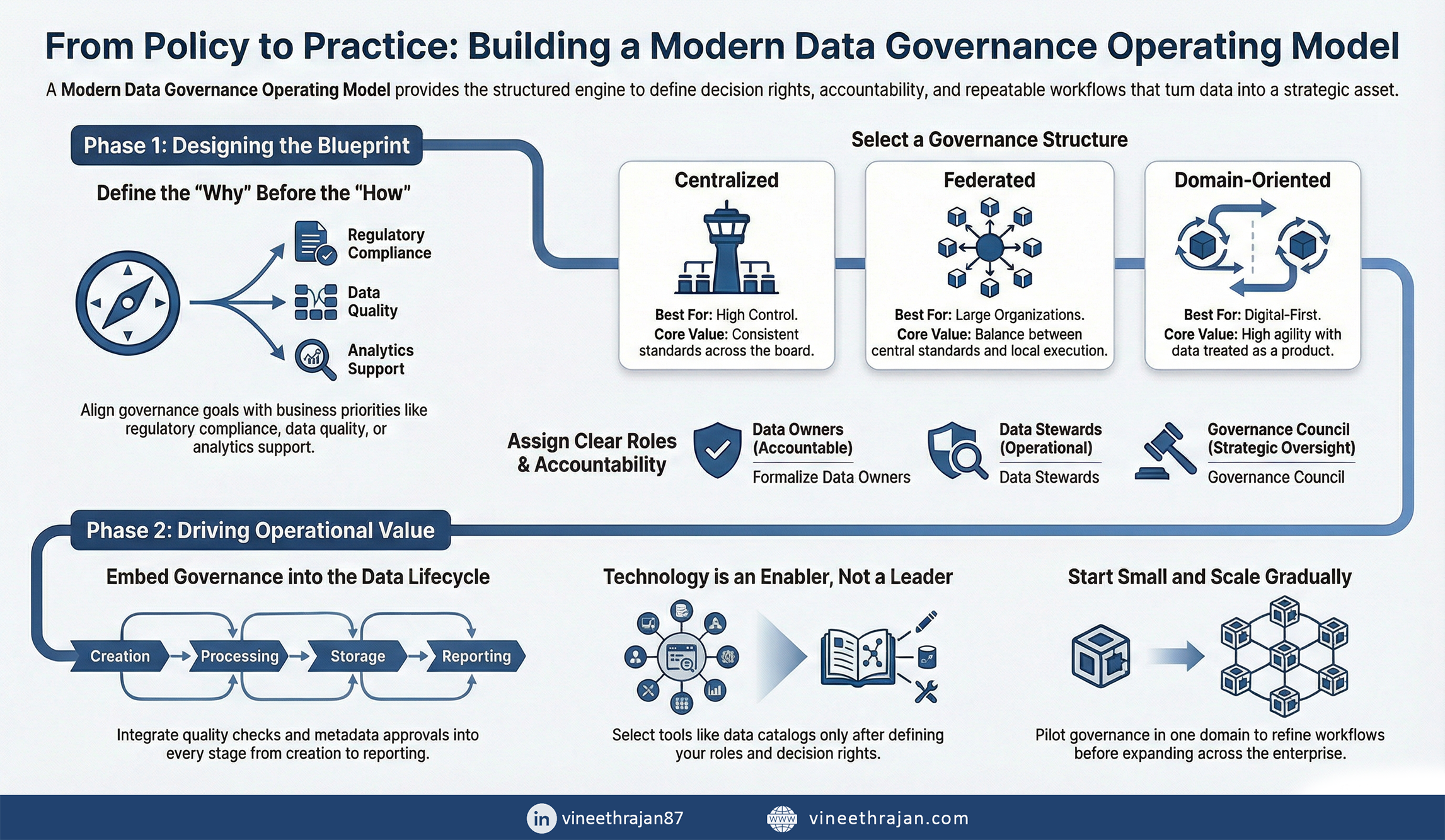
Before creating a governance operating model, it is important to clarify why your organization needs governance. The purpose could range from regulatory compliance to improving data quality, supporting analytics initiatives, reducing operational risk, or ensuring consistent reporting. Defining the goal upfront ensures that every role, process, and decision aligns with business priorities. Governance without purpose often becomes bureaucratic and burdensome, which is exactly what you want to avoid.
Choosing the Right Governance Structure
One of the first design decisions is choosing a governance structure. Traditional centralized models concentrate decision-making in a single team, which offers control but can be slow and disconnected from business units. Federated models, now the most common approach, balance control and agility by having a central team define standards while individual business domains take responsibility for execution. For highly digital organizations or those adopting data mesh principles, a domain-oriented model works well, where each business domain treats its data as a product with its own accountability. The key is to choose a structure that fits your organization’s size, culture, and maturity.
Defining Roles and Responsibilities
With the structure in place, the next step is defining clear roles and responsibilities. Every data initiative needs a set of accountable and responsible parties. Data owners are typically accountable for a domain and make final decisions on standards or conflicts. Data stewards handle the operational side, managing quality, metadata, and compliance checks. A governance council provides strategic oversight and escalation support, while IT or data engineering teams enable the technical infrastructure and tools. Clearly documenting these roles prevents confusion and ensures that governance is executed rather than ignored.
Designing Governance Processes
Equally important are the governance processes that support the operating model. Workflows for approving data definitions, resolving quality issues, managing exceptions, and updating metadata need to be structured and repeatable. Each step should define who initiates the action, who approves it, the timeline, and where the results are documented. Without these workflows, governance risks becoming reactive or inconsistent, failing to achieve its objectives.
Embedding Governance into the Data Lifecycle
Another crucial aspect is integrating governance into the data lifecycle itself. Governance cannot be an afterthought applied after systems are built or dashboards are developed. Instead, it should be embedded in every stage of the data journey, from creation and transformation to storage, analytics, and reporting. For example, before deploying a new dashboard, governance should ensure definitions are approved, quality checks are in place, and ownership is clear. This proactive approach reduces errors and builds trust in data outputs.
Technology as an Enabler
Technology supports the operating model but should never lead it. Data catalogs, metadata platforms, quality monitoring tools, and workflow automation can help enforce standards and simplify operations. However, tools cannot replace clarity in roles, decision rights, and processes. Modern organizations first define their operating model and then select the technology that enables it, ensuring that tools amplify governance rather than complicate it.
Measuring Success of Data Governance Operating Model
Measuring governance performance is another step often overlooked. To maintain executive support and demonstrate value, governance should be tied to metrics such as improvements in data quality, faster issue resolution, reduced reconciliation effort, audit readiness, and adoption of standard definitions. Tracking these metrics not only shows the business impact but also helps identify areas for continuous improvement.
Managing Change
Change management is an equally critical component. Governance changes responsibilities, accountability, and processes, which can be challenging without proper communication and training. Leaders must clearly articulate the purpose of governance, provide guidance and templates, and celebrate quick wins to reinforce adoption. A governance model is only as strong as the people who operate within it.
Starting Small and Scaling Gradually
A modern governance model should start small and scale gradually. Begin by identifying critical data elements and piloting governance in one domain. Refine workflows, clarify roles, and gradually expand to other areas of the business. Governance is a living system; it evolves with the organization, improving over time as processes and ownership mature.
Turning Governance Into a Strategic Enabler
A well-designed data governance operating model results in clear ownership, consistent reporting, faster resolution of issues, reduced risk, and trusted analytics. Governance stops being seen as a bureaucratic requirement and becomes a strategic enabler. For any organization looking to leverage its data effectively, this structured approach is no longer optional — it is essential.





8 Comments. Leave new
Hi Vineeth,
Nice article.
This data governance model will help build an effective data -driven culture through continuous learning and upskilling, inspiring through success stories and democratising the data. It also helps in establishing robust data-driven decision making processes that enables effective and efficient use of data across all levels in the organisation.
Regards,
Samir Nayak
Sales Director – APAC
Thank you for your thoughtful comment!
I appreciate your emphasis on democratizing data. When access is paired with clear governance and accountability, it empowers teams at every level to make informed, timely decisions. That balance between enablement and structure is what drives sustainable, organization-wide impact.
https://shorturl.fm/L9aqd
https://shorturl.fm/8KtpQ
https://shorturl.fm/Im7LY
https://shorturl.fm/Wggx8
https://shorturl.fm/S4wts
https://shorturl.fm/CWnjp