

Every company today claims it’s “using AI.” It’s in pitch decks, board meetings, and strategy offsites. The hype isn’t unfounded, AI tools are powerful, accessible, and evolving at extraordinary speed. But here’s the uncomfortable truth: most companies aren’t actually ready for AI. Not because the technology isn’t mature, and not because they lack ambition. They’re not ready because their organizations aren’t. The real gap in AI readiness isn’t in models or platforms. It’s in data quality, decision-making clarity, incentives, and operational alignment.
AI Readiness is not about buying software or hiring a data scientist. It’s about organizational maturity. Do you have clean, governed data? Clear decision-making processes? Incentives that support experimentation and change? AI amplifies whatever foundation already exists. Strong systems get smarter, weak systems get exposed. This isn’t criticism, it’s a diagnostic. If AI initiatives stall or fail to scale, the issue is rarely the technology itself. True AI Readiness means building the internal capacity to integrate intelligence into everyday operations, not just adopting the latest tool.
What “AI-Ready” – Actually Means
Before we talk about why companies struggle with AI, it’s important to clarify what being truly “AI-Ready” means. AI Readiness isn’t a checkbox or a one-off project. It’s a measure of whether an organization has the foundational layers in place to absorb and scale intelligence effectively. At its core, AI sits on top of several essential pillars that must be strong before the technology can deliver meaningful impact.
Being AI-Ready requires more than a shiny tool or a high-profile pilot. It starts with a business-aligned strategy that clearly connects AI initiatives to real outcomes. It demands digital maturity and the ability to leverage modern technology across the organization. It relies on process discipline so workflows are consistent, efficient, and adaptable. It depends on data reliability like accessible, accurate, and well-governed information. Strong governance frameworks ensure responsible, compliant, and ethical use of AI. And finally, it requires adoption capability. The culture, skills, and change management processes to integrate AI into everyday operations.
Without these layers in place, even the most advanced AI technology will struggle to create value. True AI Readiness is less about the algorithm and more about the organization beneath it.
The Signs Your Company Is Not Ready for AI
Adopting AI isn’t just about buying software or running pilots. It’s about organizational readiness. If your company exhibits several of the signs below, it may be struggling with AI Readiness.
Strategic Misalignment
- AI Driven by Hype
If AI initiatives start because it “sounds cool” or because competitors are talking about it, rather than solving a real business problem, it’s a warning sign. Hype-driven projects rarely deliver sustainable value. - No Clear Business Use Case
AI without a defined use case is like a car without a destination. If teams can’t clearly explain what problem the AI is solving and why it matters, adoption and impact will falter. - Extreme ROI Pressure Before Experimentation
Expecting immediate, large-scale ROI from AI pilots creates unrealistic pressure. True AI Readiness requires experimentation and iteration before measurable returns appear. - No Executive Ownership
Without a senior leader championing AI initiatives, projects lack accountability, coordination, and alignment with business priorities. AI without ownership is unlikely to scale.
Without strategic clarity, AI becomes an expensive experiment rather than a transformative capability.
Digital & Process Immaturity
- Low Digital Maturity
If core systems are outdated, disconnected, or lack automation, AI can’t integrate effectively. Organizations must first modernize digital capabilities to support intelligent tools. - Ad Hoc Workflows
When teams rely on informal or inconsistent processes, AI outputs can’t be applied reliably. Predictable, repeatable workflows are essential for scaling AI initiatives. - Broken or Undocumented Processes
Unclear, undocumented, or inefficient processes make it impossible to measure AI impact or embed it into operations. Without process clarity, AI adoption stalls. - Weak Technical Infrastructure
Poor infrastructure like slow networks, limited computing power, or fragmented systems creates bottlenecks. AI requires a robust technical foundation to perform and scale.
AI does not fix chaos, it scales it. Without solid digital and process foundations, intelligent technology amplifies existing inefficiencies.
Data & Governance Gaps
- Fragmented, Unreliable Data
When data lives in silos, is inconsistent, or lacks accuracy, AI models cannot generate reliable insights. Data quality is the backbone of AI Readiness. - Shadow Technologies
Teams often adopt unofficial tools or workarounds to fill gaps. These shadow systems create blind spots, reduce transparency, and complicate AI integration. - Legal and Compliance Are Reactive
Waiting until problems arise to address regulatory or ethical concerns leaves organizations exposed. Proactive compliance is essential for responsible AI deployment. - No Governance Framework
Without clear policies on data usage, model monitoring, and accountability, AI initiatives risk misuse, errors, and inconsistent outcomes. A governance framework ensures both safety and scalability.
If your foundation is unstable, AI magnifies the cracks. Strong data and governance practices are not optional, they’re critical to AI Readiness.
Cultural & Adoption Risks
- Low System Adoption Rates
Even the best AI tools fail if employees don’t use them. Low adoption signals a gap in training, engagement, or perceived value. - Employees Fear or Misunderstand AI
Mistrust, skepticism, or misunderstanding of AI can block progress. Teams need clarity on AI’s role and confidence in its outputs to embrace it effectively. - No Change Management Capability
AI initiatives require structured change management. Without it, new processes, roles, and workflows struggle to take hold, and pilots rarely scale.
AI failure is rarely technical, it’s organizational. Building a culture that understands, trusts, and adopts AI is a key component of true AI Readiness.
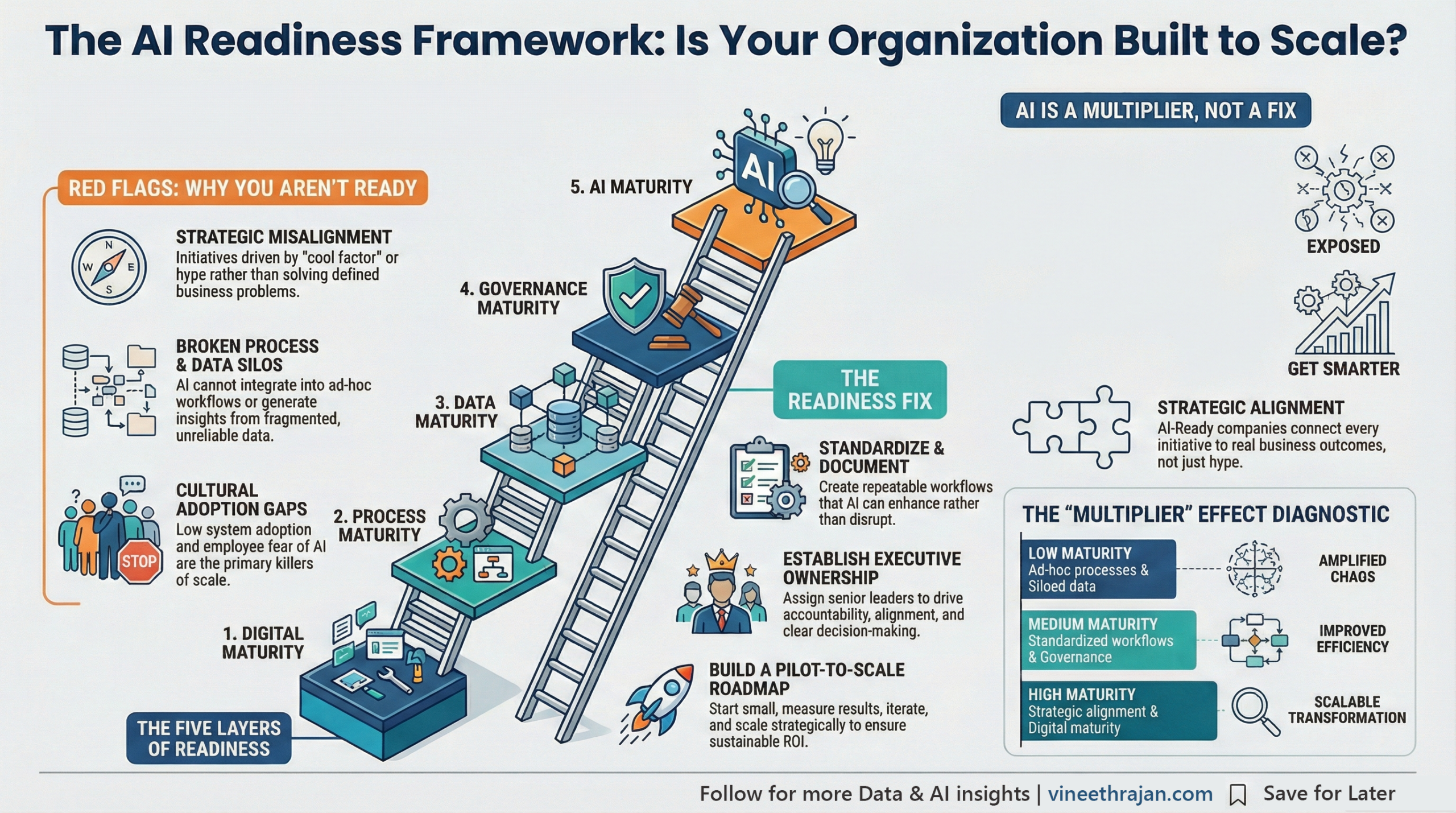
The AI Maturity Ladder
Before a company can truly harness the power of artificial intelligence, it needs more than the latest tools or a flashy pilot project. True AI Readiness is built on a foundation of digital, process, data, and governance maturity. Each layer supporting the next like rungs on a ladder. Jumping straight to AI without strengthening these fundamentals may seem faster, but it creates fragility like unreliable outputs, stalled adoption, and missed opportunities. Climbing the AI Maturity Ladder deliberately ensures that intelligence is not just deployed, but embedded, trusted, and scalable across the organization.
-
Digital Maturity: Modern, integrated systems that can support automation and intelligent tools.
-
Process Maturity: Standardized, repeatable workflows that ensure consistency and efficiency.
-
Data Maturity: Reliable, accessible, and high-quality data that AI can learn from.
-
Governance Maturity: Clear policies, accountability, and ethical frameworks for safe AI use.
-
AI Maturity: The ability to leverage AI strategically, at scale, and with measurable business impact.
What To Fix Before Investing in AI
Before investing heavily in AI, companies should focus on building the organizational foundation that ensures success. Standardizing and documenting processes creates repeatable workflows that AI can enhance rather than disrupt. Improving data governance ensures data is accurate, accessible, and compliant, giving AI models a reliable foundation. Increasing digital adoption rates helps teams embrace new tools, reducing resistance and boosting practical impact across the organization.
Equally important is establishing executive ownership to drive accountability, alignment, and clear decision-making. Finally, companies should create a pilot-to-scale roadmap that starts small, measures results, iterates, and scales strategically. By addressing these five focus areas first, organizations turn AI from a risky experiment into a disciplined, scalable capability, making technology work for them, rather than the other way around.
AI Is a Multiplier
AI doesn’t create value on its own, it amplifies what’s already there. It multiplies strengths, accelerating high-performing teams, optimized processes, and reliable data. But it also multiplies weaknesses, exposing fractured workflows, poor data quality, and misaligned priorities. The difference between success and failure comes down to AI Readiness: how well an organization has built the foundational layers to absorb and scale intelligence.
The companies that win with AI aren’t the fastest adopters or the ones chasing the latest tool. They’re the ones that are structurally prepared with mature processes, reliable data, clear governance, and a culture ready to embrace change. AI is powerful, but its true potential only emerges when readiness meets ambition.





5 Comments. Leave new
https://shorturl.fm/9gmWn
https://shorturl.fm/L9aqd
https://shorturl.fm/9x1oB
https://shorturl.fm/yRy5E
https://shorturl.fm/cLv1D