

AI-ready data vs analytics-ready data is one of the most important distinctions in modern data engineering and data strategy. As organizations shift toward data-driven decision-making and artificial intelligence, understanding how these two types of data are created and used becomes essential.
While both originate from the same raw data sources, AI-ready data vs analytics-ready data serves very different purposes. One focuses on business reporting and insights, while the other powers machine learning models and predictive systems. Companies today are building unified data platforms that support both simultaneously, enabling faster insights and smarter automation.
AI-ready data vs analytics-ready data: What it means?
To understand AI-ready data vs analytics-ready data, it is important to define each clearly.
Analytics-ready data refers to data that has been cleaned, structured, and organized so it can be used for dashboards, reporting, and business intelligence. It helps organizations answer questions like what happened and how performance is changing over time.
AI-ready data, on the other hand, is data that has been engineered specifically for machine learning models. It is designed to help systems predict outcomes, detect patterns, and automate decisions. This includes feature engineering, labeling, scaling, and encoding.
Key difference in purpose
- Analytics-ready data → Understanding and reporting
- AI-ready data → Prediction and automation
In simple terms
- Analytics-ready data explains the past
- AI-ready data predicts the future
Understanding AI-ready data vs analytics-ready data helps organizations design better data systems that serve both business intelligence and artificial intelligence needs.
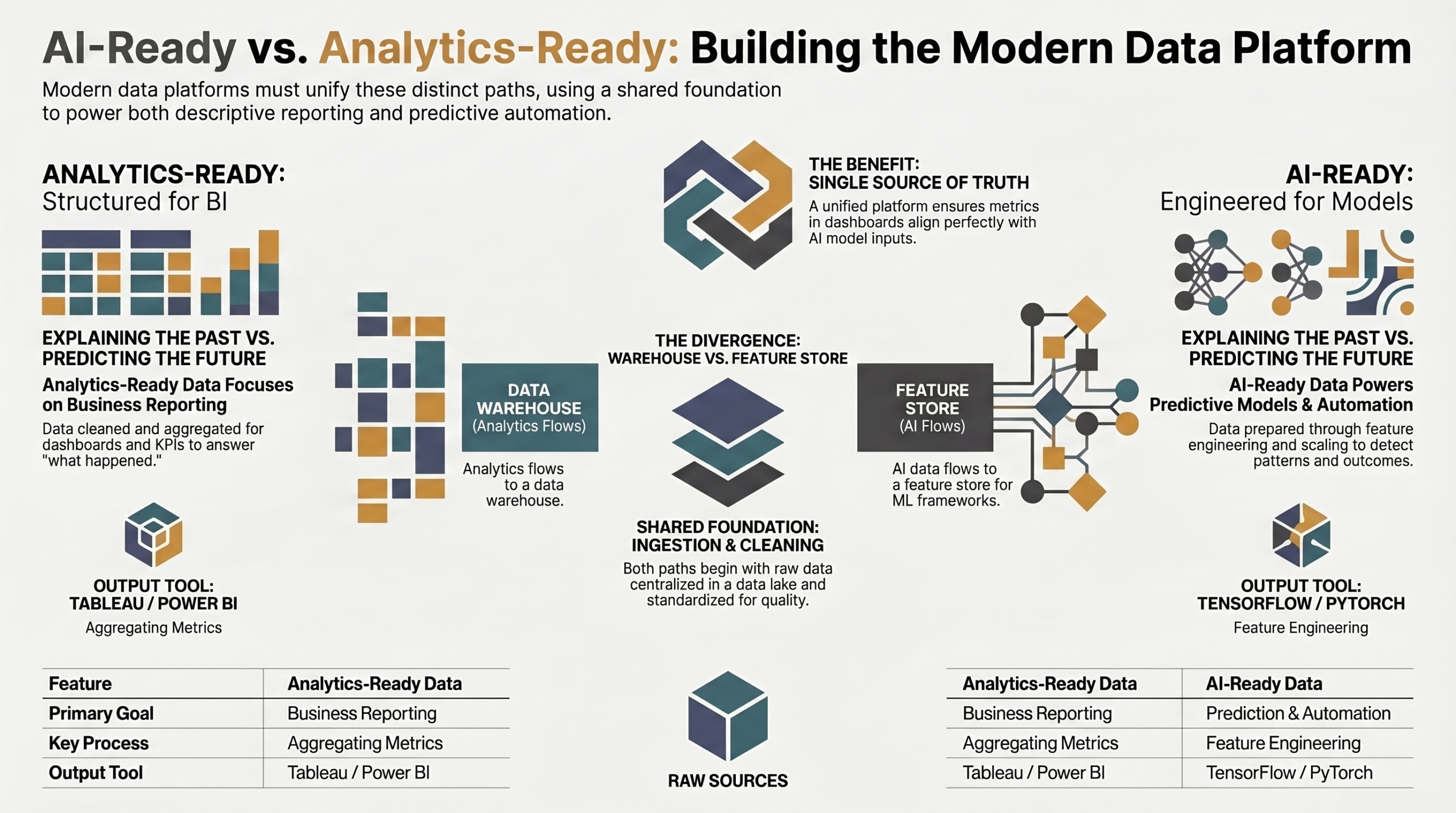
AI-ready data vs analytics-ready data in modern data platforms
Modern companies do not treat AI-ready data vs analytics-ready data as separate systems. Instead, they build a unified data platform where both are created from the same foundation.
This shared architecture ensures consistency, scalability, and efficiency across teams.
1. Raw data ingestion layer
Everything begins with raw data collected from multiple sources:
- Applications and mobile apps
- CRM and ERP systems
- Website and clickstream logs
- IoT devices and external APIs
This data is stored in a centralized repository such as a data lake. At this stage, it is unstructured and not usable for either analytics or AI.
2. Data processing and cleaning layer
Before becoming either analytics-ready or AI-ready, data must be cleaned:
- Removing duplicates
- Handling missing values
- Standardizing formats (dates, currencies, IDs)
- Validating data quality
This creates a consistent foundation for both paths of AI-ready data vs analytics-ready data.
3. Analytics-ready data layer (Business intelligence layer)
At this stage, raw data is transformed into structured datasets optimized for reporting.
This includes:
- Aggregating metrics (daily revenue, monthly users)
- Joining datasets across systems
- Applying business logic definitions
- Creating KPIs and dashboards
This layer is used by BI tools such as Tableau and Power BI.
This is where AI-ready data vs analytics-ready data diverges. Analytics focuses on summarization and clarity.
4. AI-ready data layer (Machine learning layer)
The AI layer transforms the same data into a format suitable for machine learning models.
This involves:
- Feature engineering
- Label creation
- Encoding categorical variables
- Normalizing numerical values
- Preparing unstructured data (text, images, logs)
This layer supports frameworks like TensorFlow and PyTorch.
Unlike analytics-ready data, AI-ready data is optimized for prediction rather than reporting.
How companies build both in a single platform
A modern approach to AI-ready data vs analytics-ready data is to build a single unified data platform with multiple transformation layers.
Step 1: Centralize raw data: All data is ingested into a single data lake or cloud storage system. This ensures one source of truth for both analytics and AI.
Step 2: Build transformation pipelines: Data engineers create pipelines that split processing into two paths:
- Business transformation for analytics-ready data
- Feature engineering for AI-ready data
Both pipelines use the same raw input but produce different outputs.
Step 3: Create a data warehouse for analytics: The analytics layer is optimized for performance and query ability. It stores structured datasets that power dashboards and reports. This is where AI-ready data vs analytics-ready data starts to diverge clearly in usage.
Step 4: Build a feature store for AI: The AI layer is often stored in a feature store that manages reusable features for machine learning models. This ensures consistency across training and production systems.
Step 5: Enable cross-team collaboration Modern platforms allow:
- Data analysts to access analytics-ready data
- Data scientists to access AI-ready data
- Engineers to maintain shared pipelines
This reduces duplication and improves efficiency.
Benefits of combining Both in one platform
Building both within the same platform offers major advantages:
Single source of truth: All teams work from the same raw data foundation
Faster development: No need to rebuild pipelines for each use case
Improved consistency: Metrics used in dashboards and AI models stay aligned
Scalability: New analytics and AI use cases can be added easily
Better decision-making: Organizations gain both descriptive insights and predictive intelligence
AI-ready data vs analytics-ready data is not just a technical distinction. It is a strategic foundation for modern data-driven organizations. Analytics-ready data helps businesses understand what has happened, while AI-ready data enables them to predict what will happen next.
The most successful companies do not choose between the two. Instead, they build unified data platforms that support both, ensuring that raw data flows through shared systems and is transformed into multiple valuable outputs.
In the future, the gap between AI-ready data vs analytics-ready data will continue to shrink as platforms become more integrated. Organizations that invest in strong data foundations today will be best positioned to leverage both analytics and AI at scale.





25 Comments. Leave new
https://shorturl.fm/4V1m6
https://shorturl.fm/wrzdG
https://shorturl.fm/7sFhT
https://shorturl.fm/mXkgs
https://shorturl.fm/Fr1JI
https://shorturl.fm/ZTdX2
https://shorturl.fm/zerOa
https://shorturl.fm/ZCZe6
https://shorturl.fm/fzFc6
https://shorturl.fm/2VNpy
https://shorturl.fm/YDqMy
https://shorturl.fm/Lwnqo
https://shorturl.fm/XLcDD
https://shorturl.fm/nwpi9
https://shorturl.fm/YS95V
https://shorturl.fm/MoJjd
https://shorturl.fm/rBXDm
https://shorturl.fm/7kAYa
https://shorturl.fm/ADizv
https://shorturl.fm/MguuF
https://shorturl.fm/HFMd4
https://shorturl.fm/ZLWMb
https://shorturl.fm/uumK7
https://addlinks.pro/ggrFP
https://addlinks.pro/kawrG