

Fragmented Data in Data Governance is one of the most persistent and costly challenges organizations face today. As businesses expand across cloud platforms, SaaS tools, departments, and geographies, their data often becomes scattered, duplicated, and inconsistent. The result? Poor decision-making, compliance risks, operational inefficiencies, and lost strategic value.
If your organization struggles with disconnected systems or inconsistent reporting, you are likely dealing with fragmented data. The good news is that with the right governance framework, you can bring order to the chaos and transform your data ecosystem into a unified, strategic asset.
What Is Fragmented Data in Data Governance?
Fragmented Data in Data Governance refers to data that is isolated across multiple systems, departments, or platforms without standardized oversight, integration, or ownership.
Common causes include:
- Departmental data silos
- Legacy systems and outdated infrastructure
- Mergers and acquisition
- Rapid SaaS adoption
- Lack of enterprise-wide data standards
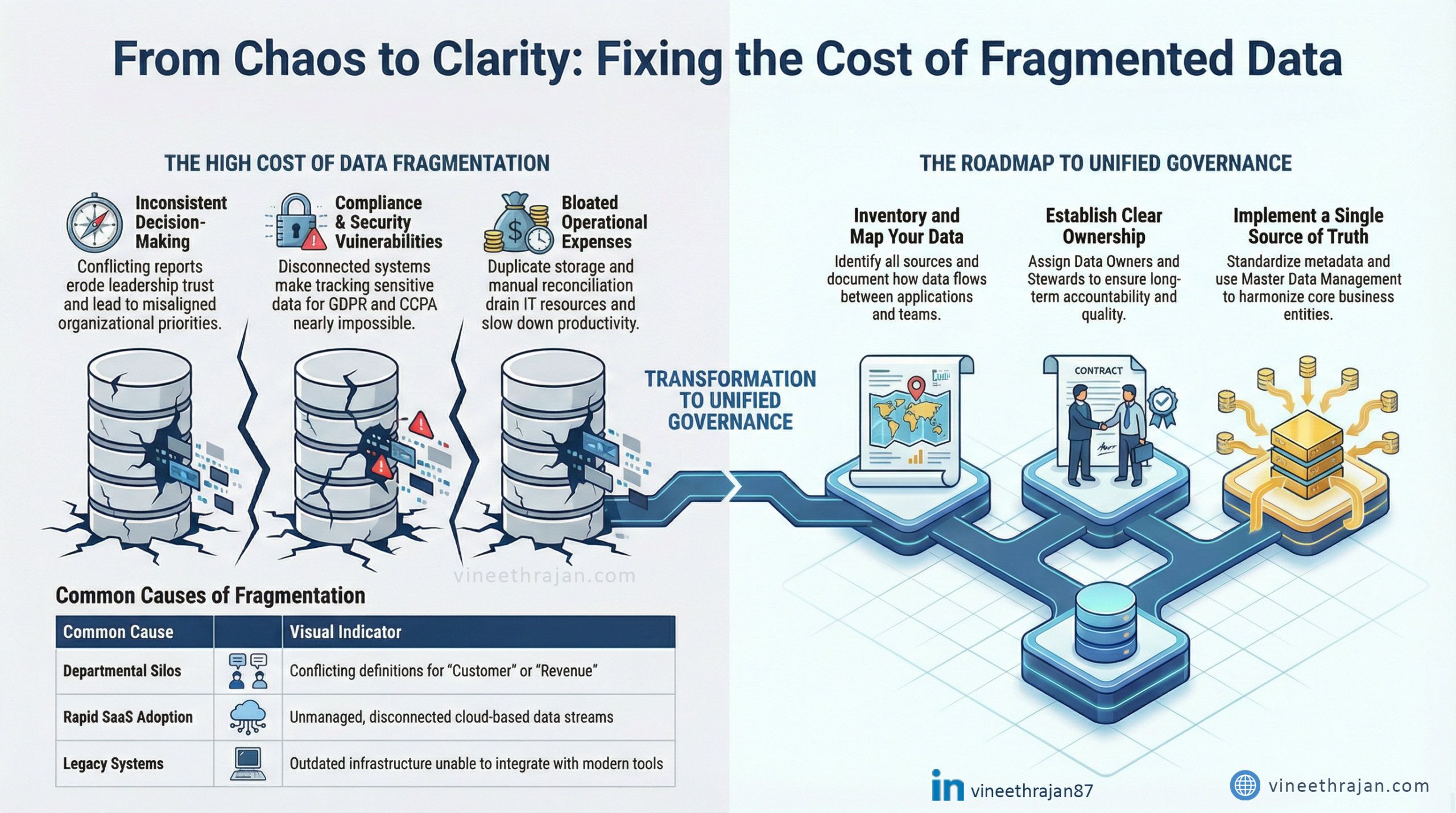
For example, marketing may rely on a CRM platform, finance on an ERP system, and operations on separate analytics tools – each with different definitions for “customer,” “revenue,” or “active account.” Without centralized governance, inconsistencies multiply.
Why Fragmented Data in Data Governance Is a Strategic Risk
Fragmented data is not just inconvenient, it is risky.
1. Inconsistent Decision-Making
When leadership teams encounter conflicting reports from different departments, trust in data quickly erodes. This inconsistency is a strategic risk because decisions made on inaccurate or incomplete information can lead to misaligned priorities, wasted resources, regulatory missteps, and missed market opportunities. In essence, unreliable data undermines an organization’s ability to execute its strategy effectively. By standardizing and consolidating data, companies reduce this risk, ensuring leaders can make accurate, insight-driven decisions that support long-term business objectives.
2. Compliance Vulnerabilities
Regulations such as the General Data Protection Regulation (GDPR) and the California Consumer Privacy Act (CCPA) require organizations to accurately track and manage personal data. Data fragmentation creates significant compliance risks because it becomes difficult to identify where sensitive information is stored, respond promptly to subject access requests, or enforce proper deletion and retention policies. Without centralized, consistent data management, organizations face potential fines, legal exposure, and reputational damage, making compliance a critical priority.
3. Increased Security Risks
Disconnected systems often mean inconsistent access controls. Without unified governance, it becomes harder to monitor who has access to what data. Frameworks from the National Institute of Standards and Technology emphasize centralized oversight for this reason.
4. Higher Operational Costs
Duplicate data storage, manual reconciliation, and inefficient workflows drive up operational expenses across the organization. Maintaining multiple versions of the same information not only consumes storage and IT resources but also requires additional staff time to validate and correct errors. These inefficiencies divert resources from strategic initiatives, making it more costly to operate and slowing the organization’s ability to respond to business needs. Streamlined, accurate, and centralized data reduces these costs while improving overall productivity.
How to Address Fragmented Data in Data Governance
Solving Fragmented Data in Data Governance requires a structured, enterprise-wide approach.
Step 1: Conduct a Data Inventory and Mapping Exercise
You can’t fix what you can’t see. So the first step toward stronger data governance is conducting a thorough data inventory and mapping exercise. Begin by identifying all data sources across your organization, from internal systems to third-party platforms. Then map how data flows between systems, applications, and teams to understand where it originates, how it moves, and where it is stored. Clearly document data owners to establish accountability, and classify sensitive data based on its level of risk and regulatory impact. This process creates much-needed visibility across the organization, forming the foundation for better security, compliance, and decision-making.
Step 2: Establish Clear Data Ownership
Every critical dataset should have clearly defined ownership to ensure accountability and effective oversight. At a minimum, this means assigning a data owner who is ultimately accountable for data quality, governance, and regulatory compliance, as well as a data steward who manages the day-to-day operational oversight of that data. Establishing these roles eliminates ambiguity around responsibility, reduces risk, and prevents datasets from becoming “orphaned” without clear accountability or maintenance.
Step 3: Standardize Definitions and Metadata
Create a centralized data dictionary that clearly defines business terms, KPIs, reporting standards, and naming conventions across the organization. By establishing a single, authoritative source of truth, teams can ensure consistency in how data is interpreted and used. This level of standardization reduces confusion, minimizes reporting discrepancies, and aligns departments around shared definitions and metrics, ultimately improving collaboration and decision-making.
Building a Framework to Prevent Fragmented Data in Data Governance
Prevention is as important as remediation.
Implement Master Data Management (MDM)
Master Data Management (MDM) consolidates core business entities such as customers, products, vendors, and employees into a unified and governed framework. By harmonizing these critical data domains across systems, MDM eliminates duplication, resolves inconsistencies, and standardizes records across the organization. The result is a reliable single source of truth that improves reporting accuracy, operational efficiency, and strategic decision-making.
Integrate Systems Strategically
Instead of simply layering tools on top of existing systems, organizations should prioritize seamless integration through API-based connections, centralized data warehouses or data lakes, and real-time data synchronization. Leveraging cloud-based architectures further enhances scalability, enabling systems to communicate efficiently, reduce data silos, and support agile, data-driven decision-making across the enterprise.
Align Governance With Enterprise Strategy
Fragmented data often persists when data governance is treated solely as an IT initiative. To achieve lasting impact, governance must involve executive leadership, align governance KPIs with broader business objectives, and be integrated into enterprise risk management processes. This holistic approach ensures accountability, drives organizational alignment, and supports the long-term sustainability of data governance efforts.
Practical Strategies to Reduce Fragmented Data in Data Governance
Here are actionable strategies your organization can implement immediately:
1. Create a Data Governance Council
Establishing a Data Governance Council brings together a cross-functional team to ensure alignment across IT, compliance, legal, finance, and operations. By fostering collaboration among these key stakeholders, the council helps break down silos, promotes consistent policies and standards, and drives coordinated decision-making across the organization.
2. Adopt Automated Data Quality Monitoring
Adopt automated data quality monitoring to maintain reliable and trustworthy data across your organization. Leverage tools that can detect duplicates, flag inconsistencies, monitor data lineage, and track compliance with established policies. By automating these processes, organizations can improve accuracy, reduce manual effort, and scale data quality management as the volume and complexity of data grow.
3. Prioritize High-Risk Data First
Prioritize high-risk data first by directing initial governance and quality efforts toward datasets that carry the greatest business and regulatory impact, such as customer personal information, financial reporting data, and regulatory reporting datasets. By taking this risk-based approach, organizations can address critical vulnerabilities quickly, reduce exposure, and deliver measurable impact early in their data governance initiatives.
4. Develop a Data Integration Roadmap
Develop a data integration roadmap that emphasizes strategic, incremental progress rather than attempting a full-scale overhaul. Focus on quick wins, high-value integrations, and phased modernization of systems to ensure tangible benefits early on. This approach minimizes disruption, builds organizational confidence, and sets the stage for sustainable, long-term improvements in data management and connectivity.
Benefits of Eliminating Fragmented Data in Data Governance
When data fragmentation is effectively addressed, organizations see tangible, measurable benefits. Reporting accuracy improves, enabling faster and more informed decision-making. Compliance posture strengthens, operational costs decrease, and customer trust is enhanced. Most importantly, leadership gains renewed confidence in the integrity and reliability of enterprise data, empowering the organization to act decisively and strategically.
Common Mistakes to Avoid
Even well-planned initiatives can fail if common pitfalls are ignored.
- Treating Integration as a One-Time Project
Data environments evolve constantly. Governance must be continuous.
- Ignoring Change Management
Employees must understand new standards and processes. Training is critical.
- Overengineering the Solution
Start practical. Focus on business value before implementing overly complex architectures.
- Neglecting Executive Sponsorship
Without leadership support, fragmented data problems resurface quickly.
And the Final Words
Fragmented Data in Data Governance can quietly undermine strategy, compliance, and operational efficiency. Left unaddressed, it increases risk and weakens organizational resilience.
However, with clear ownership, standardized definitions, system integration, and executive alignment, fragmented data can be transformed into a unified and strategic asset.
Now is the time to assess your data landscape. Conduct a comprehensive data inventory, build a governance framework that aligns with business goals, and eliminate silos before they limit your growth. A unified data strategy is not just a technical upgrade – it is a competitive advantage.





6 Comments. Leave new
https://shorturl.fm/RISaT
https://shorturl.fm/qgfzZ
https://shorturl.fm/Iqgsb
https://shorturl.fm/vxNVy
https://shorturl.fm/N0gUt
https://addlinks.pro/jkuAI